
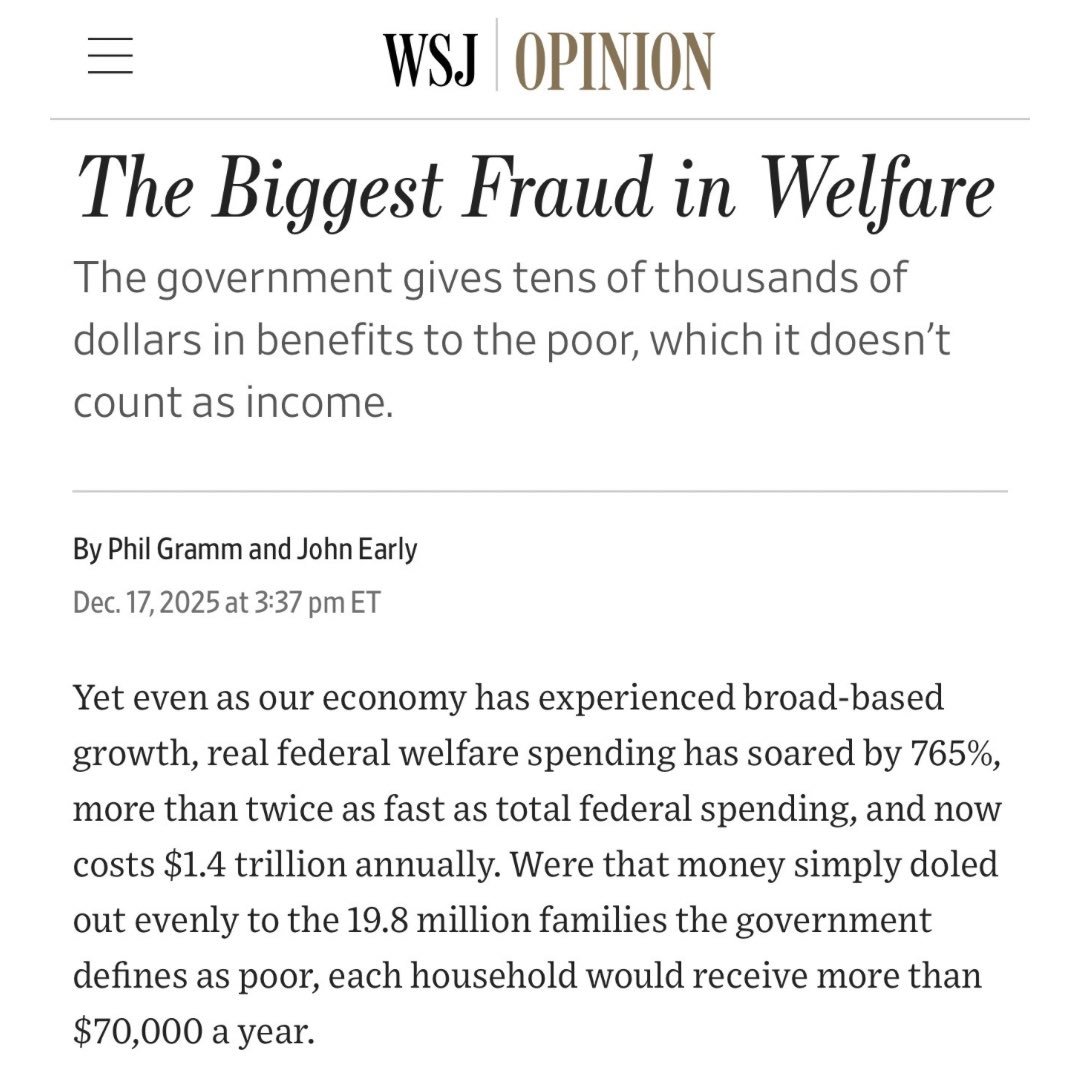
In a provocative Wall Street Journal opinion piece published on December 17, 2025, former Senator Phil Gramm and economist John Early argue that the U.S. welfare system harbors its “biggest fraud”—not through outright theft, but by systematically excluding massive government benefits from official income calculations.
The authors highlight that real federal welfare spending has skyrocketed by 765% over recent decades, growing more than twice as fast as overall federal outlays, now reaching an estimated $1.4 trillion annually. This includes means-tested programs like Medicaid, food stamps (SNAP), housing subsidies, and refundable tax credits.
Yet, the official poverty measure—used by the Census Bureau—ignores these non-cash transfers when determining household income. As a result, the government classifies 19.8 million families as “poor,” despite providing them with substantial aid.
Gramm and Early calculate that if this $1.4 trillion were distributed evenly as cash to those households, each would receive over $70,000 per year—far exceeding typical poverty thresholds. They contend this omission allows many recipients to exceed income limits for continued eligibility, effectively overpaying benefits while perpetuating a misleading narrative of persistent poverty.
Amid broad economic growth in recent years, the piece asserts that lower-income Americans have seen significant living standard improvements, but flawed metrics obscure this progress. The authors warn that without counting transfers as income, the system incentivizes dependency and distorts policy debates on inequality.
Critics of such views often point to the Supplemental Poverty Measure (SPM), which does account for many benefits and shows lower effective poverty rates. Nonetheless, Gramm and Early’s analysis, building on their book The Myth of American Inequality, challenges policymakers to rethink how welfare success is measured.
Sources:
- https://www.aei.org/op-eds/the-biggest-fraud-in-welfare/ (Republished WSJ op-ed by Gramm and Early)
- https://www.edwardconard.com/macro-roundup/counting-non-cash-benefits-as-income-would-reduce-the-19-8mm-us-households-defined-as-poor-by-90-if-the-1-4t-in-annual-federal-poverty-spending-including-non-cash-benefits-were-distributed-in-cash/?view=detail&filters=macro-roundup-database (Summary and key figures from the op-ed)
- https://www.amazon.com/Myth-American-Inequality-Government-Biases/dp/1538167387 (Gramm, Early, and Ekelund’s book expanding on these arguments)