WASHINGTON — Tell the working man the pump jumped because “supply changed.” Then ask him what warehouse emptied in twenty-four hours. Nothing did. The barrels did not vanish. The story did.
WTI spent this month swinging from the low nineties toward $105 and back under $96. Brent kissed near $110 and settled around $103–$104. That is not a well running dry on a Tuesday. That is a market that lives on quotas, futures, war-risk premiums, and a handful of ministries that can add or withhold more oil with a communiqué than any American stripper well can produce in a year. OPEC+ just froze October output after a paper increase. They call it “market management.” The honest word is cartel.
Price is a geopolitical tool. It has always been. Embargoes broke the 1970s. Glut politics broke producers in the 1980s. Spare capacity in Riyadh and the paper market in New York can punish a currency, a farmer, or an incumbent faster than a Senate bill. The medical complex sells pills. The oil complex sells the cost of living. When diesel, freight, fertilizer, and airfare move together, every household feels the tax — and no legislature voted on it.
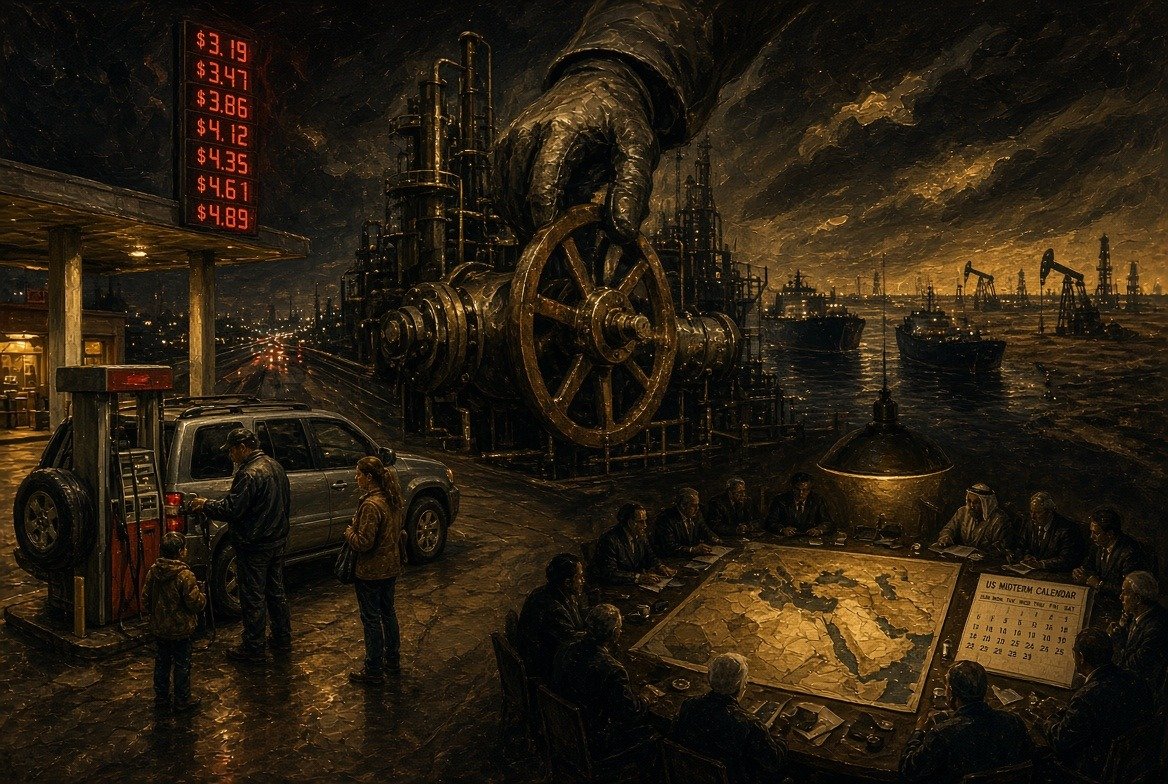
Watch the calendar. Midterms are the next scoreboard. A sudden squeeze at the pump is the oldest way to make a sitting coalition look like it cannot run a country. Foreign producers do not love the American voter. They love the number that keeps their budgets whole. Domestic majors do not set OPEC quotas, but they live inside the same administered price and they do not weep when volatility fattens the hedge book.
So no: oil is not a farmer’s market. It is a valve. Someone’s hand is on it. God bless the people who still pay cash at the pump and refuse the fairy tale.
— Josiah Hale, WAA1776
References