







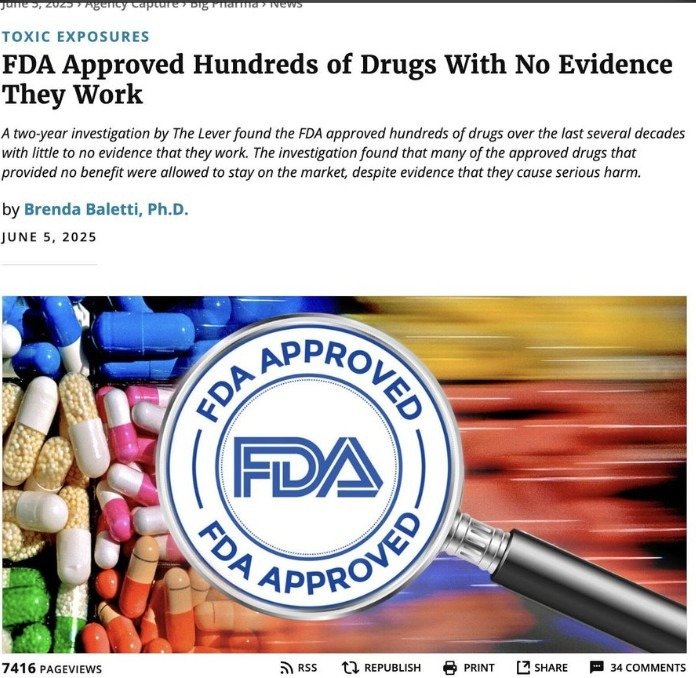
A shocking two-year investigation by The Lever has revealed that the U.S. Food and Drug Administration (FDA) has approved hundreds of drugs over the past several decades with little to no evidence of their effectiveness, allowing many to remain on the market despite reports of serious harm. The findings, published in June 2025, expose significant flaws in the FDA’s drug approval process, raising urgent questions about public safety and regulatory oversight.
The investigation, conducted by medical journalists Jeanne Lenzer and Shannon Brownlee, analyzed government records, internal FDA documents, congressional testimony, court records, and interviews with over 100 experts, patients, and former regulators. It found that from 2013 to 2022, 73% of the 429 drugs approved by the FDA failed to meet the agency’s four foundational standards for demonstrating effectiveness: the presence of a control group, replication in two well-conducted trials, blinding of participants and investigators, and the use of clinical endpoints like symptom relief or extended survival. Alarmingly, 55 drugs met only one of these standards, and 39 met none.
Cancer drugs were particularly concerning, with only 2.4% of the 123 approved from 2013 to 2022 meeting all four criteria. Eighty-one percent were approved based on surrogate endpoints, such as tumor shrinkage, which often fail to correlate with improved survival or quality of life. For example, Copiktra, approved in 2018 for leukemia and lymphoma, was linked to serious complications in two-thirds of patients and reduced survival by 11 months compared to a comparator drug. Despite these findings, it remained on the market until the manufacturer voluntarily withdrew it for one indication in 2021.
The investigation highlights a shift in FDA policy, driven by pharmaceutical industry lobbying and patient advocacy groups, toward approving drugs based on preliminary data with the expectation that post-market studies will confirm efficacy. However, many of these follow-up studies are either delayed or rely on the same flawed surrogate measures, leaving patients as “unwitting guinea pigs” for drugs that may offer no benefit and cause significant harm. An estimated 128,000 deaths annually are attributed to side effects from prescription drugs, underscoring the scale of the issue.
Critics, including Yale physician Reshma Ramachandran, argue that the FDA’s reliance on industry funding—two-thirds of its drug review budget comes from user fees—compromises its independence. “We need an agency that uses high-quality science to assess safety and efficacy,” Ramachandran told The Lever. The investigation also points to historical changes, such as relaxed standards following the AIDS crisis in the 1980s, which prioritized faster approvals over rigorous evidence.
The FDA’s failure to withdraw harmful drugs, even after evidence of ineffectiveness or danger, has sparked calls for reform. Experts like Jerome Hoffman, a UCLA professor emeritus, argue that the agency’s primary goal should be ensuring drugs are more likely to help than harm. For now, patients and doctors remain largely unaware of the risks, trusting an approval process that appears increasingly broken.
References:
- The Lever Investigation: https://childrenshealthdefense.org/defender/fda-approved-hundreds-drugs-no-evidence-they-work/
- The Lever Article:https://truthout.org/articles/fda-approved-hundreds-of-drugs-without-evidence-they-work-many-are-dangerous/
- Jacobin Report: https://jacobin.com/2025/06/fda-approval-drugs-effectiveness-risk
- Maryanne Demasi Blog: https://blog.maryannedemasi.com/p/fda-exposed-hundreds-of-drugs-approved












+ There are no comments
Add yours