






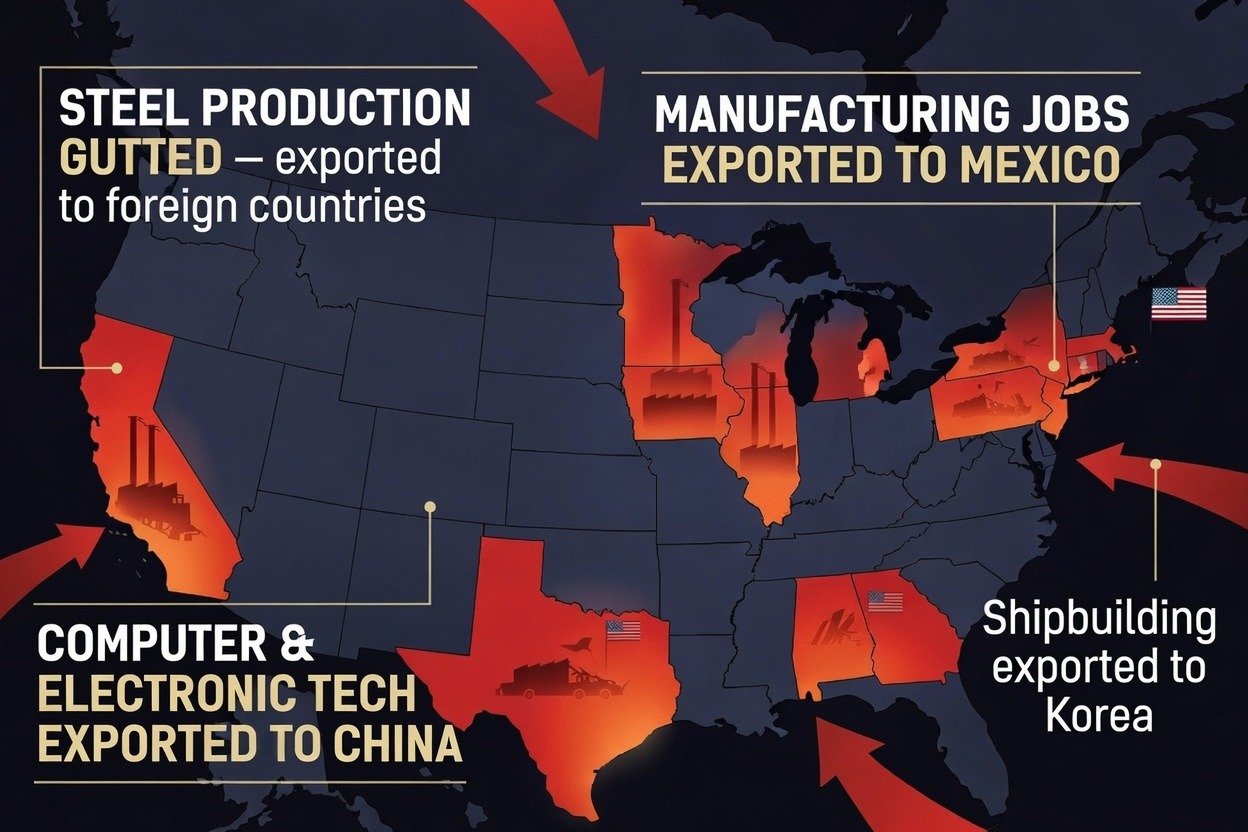
For decades, bipartisan political leaders in Washington championed “free trade” agreements that systematically exported American manufacturing jobs and national wealth overseas. The results are clear: hollowed-out communities, stagnant wages for working families, and a massive transfer of productive capacity to foreign competitors—while connected politicians and their corporate backers thrived.
The North American Free Trade Agreement, pushed by President Bill Clinton and supported by Republican leadership in 1993, eliminated tariffs with Mexico and Canada. Far from delivering promised prosperity, it accelerated factory closures. Estimates from the Economic Policy Institute and others put net U.S. job losses from NAFTA in the range of 680,000 to over one million, concentrated in the industrial Midwest and South. Workers without college degrees saw real wage pressure as production shifted to lower-cost labor markets.
China’s entry into the World Trade Organization, sealed by permanent normal trade relations under Clinton in 2000, proved even more devastating. Between 2001 and the early 2010s, the exploding trade deficit with China displaced 2.8 to 3.8 million American jobs, the vast majority in manufacturing. Entire sectors—textiles, electronics, furniture, steel—were gutted. Over five million manufacturing positions vanished in two decades as companies chased cheap labor and weak regulations abroad.
These outcomes were not accidents of market forces alone. Trade policy was shaped by intensive corporate lobbying from multinational firms that stood to profit from offshoring. Politicians who advanced these deals frequently received substantial campaign contributions from the same interests, later enjoyed revolving-door positions, or saw personal networks benefit from the resulting globalization. The status quo rewarded those who treated American workers as expendable while shareholders and financial elites captured the gains. Cheap imports papered over the damage for a time, but the long-term cost has been eroded industrial capacity, weakened national security, and a working class that correctly senses it was betrayed.
Restoring American manufacturing requires rejecting the failed orthodoxy that prioritizes abstract efficiency and foreign markets over domestic production and the citizens who built this country.
References https://www.epi.org/publication/growing-trade-deficit-china-cost-2-8-million/ https://www.nytimes.com/2024/09/03/magazine/nafta-tarriffs-economy-trump-kamala-harris.html https://prosperousamerica.org/trade-agreements-the-export-myth-that-masked-a-national-giveaway/














+ There are no comments
Add yours