





Sacramento, CA – August 31, 2025 – California, under Governor Gavin Newsom, continues to be a stronghold of Democratic control, a status critics attribute to decades of strategic gerrymandering that shapes electoral outcomes in favor of the party. Recent data, highlighted in a viral X post by Shiloh Marx (
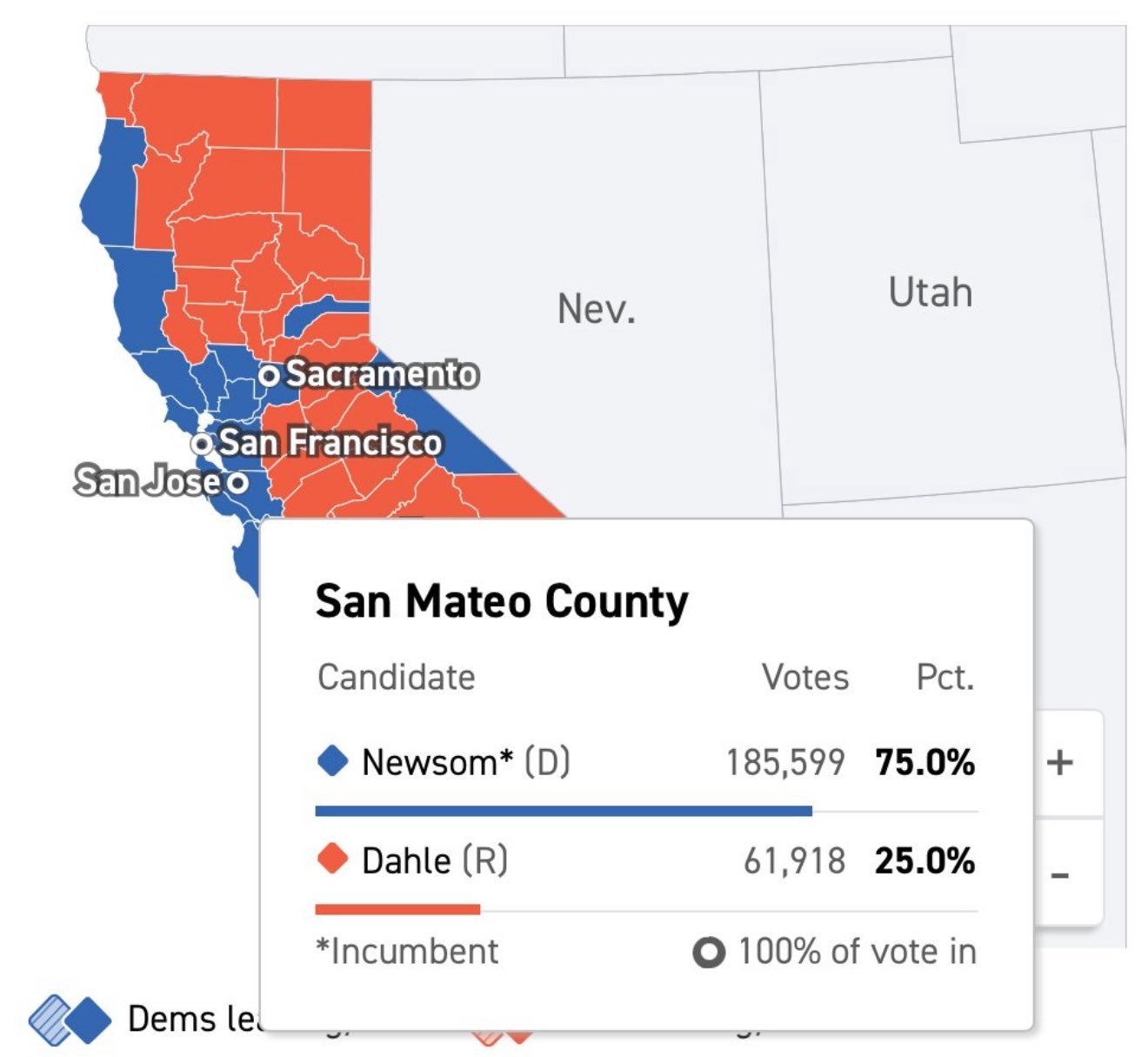
@Shilohmarx, August 30, 2025), has reignited debates about the state’s political landscape, suggesting that its “blue” reputation may be less a reflection of voter preference and more a product of manipulated district lines. With Newsom securing 75% of the vote in San Mateo County against Republican Brian Dahle’s 25% in the 2022 gubernatorial race, the question arises: is California’s political identity genuinely representative, or a carefully crafted illusion? The X post, accompanied by maps showing red-leaning inland counties juxtaposed against blue coastal strongholds, points to the removal of 109,851 ineligible voters in San Mateo County and 33,871 in Santa Barbara County as evidence of potential electoral irregularities. Marx argues that these removals expose a rigged system, claiming, “California isn’t blue—it’s been rigged blue.” The maps, sourced from election data, depict a state where Democratic dominance is concentrated in urban centers like San Francisco and Los Angeles, while rural areas lean heavily Republican. This polarization, critics say, is exacerbated by gerrymandering, a practice where district boundaries are redrawn to favor one party, often resulting in lopsided electoral victories.Historically, California’s redistricting has been contentious. The 1980s saw Democratic Congressman Phillip Burton craft a plan dubbed “modern art” for its convoluted shapes, securing five new Democratic seats. Although voters rejected it in 1982, subsequent efforts under Democratic control have maintained the advantage. The 2010 passage of Proposition 20 aimed to curb gerrymandering by entrusting redistricting to an independent commission, yet critics argue the process remains susceptible to partisan influence, with California’s 52 congressional districts still favoring Democrats 40 to 12, per the 2022 election results.Newsom’s administration has dismissed these claims, emphasizing California’s progressive policies and high voter turnout as the true drivers of Democratic success. However, the removal of ineligible voters—mandated under the National Voter Registration Act—raises questions about past oversight. If significant numbers of ineligible votes were cast, as Marx suggests, it could imply a systemic issue affecting outcomes like Newsom’s 61.9% retention in the 2021 recall election. The debate extends beyond California, mirroring trends in other Democratic-controlled states like New York and Illinois, where gerrymandering has similarly entrenched power. A 2023 Brennan Center report noted that while voter fraud is rare, perceptions of manipulation can erode trust, a sentiment echoed in conservative circles on X.As the 2026 midterms approach, pressure mounts for reform. Republican lawmakers, citing the X post’s evidence, are pushing for stricter voter roll maintenance and independent audits. Meanwhile, Newsom’s office has yet to comment on the specific allegations, focusing instead on policy achievements. This controversy underscores a broader national divide over electoral integrity. Whether California’s blue dominance is a product of gerrymandering or genuine voter will remains a contentious issue, one that may shape future political battles.
Removing ineligible voters is removing the votes democrats and Gavin have rigged elections with —
— Shiloh Marx (@Shilohmarx) August 30, 2025
These counties removed:
Santa Barbara: -33,871
San Mateo: –109,851
California isn't blue — it's been rigged blue. pic.twitter.com/QQOCYLlFIt
References: