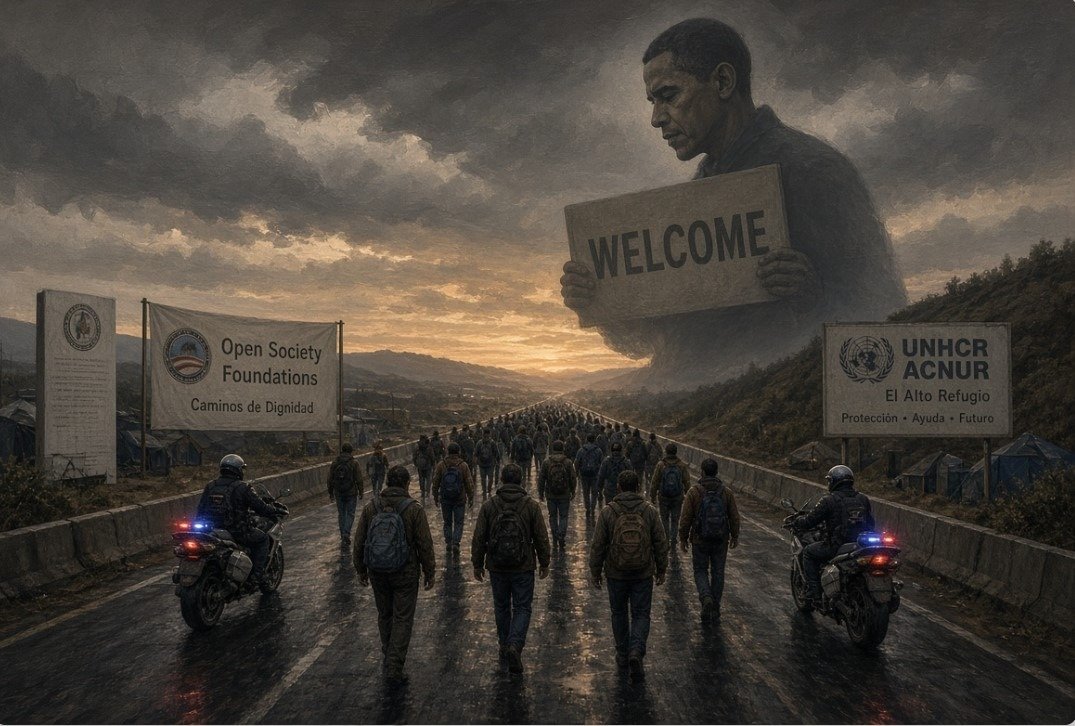
WASHINGTON — A column that named itself Fe y Esperanza left San Pedro Sula on September 20, crossed Guatemala in pieces, and presented itself at the Rodolfo Robles bridge at Suchiate on the twenty-fourth. Local papers, EFE, and a Department of Homeland Security statement issued to Fox agree on the skeleton of the march: a few hundred at the line, nearer six hundred after Tapachula gathered the stranded, Honduran names joined by Salvadoran, Guatemalan, Ecuadorian, Haitian, and Cuban ones, U.S. Border Patrol “actively tracking.” Mexican immigration officers and municipal police walked with them at the crossing. That escort is not a rumor invented for a midterm. It is the posture of a state that has decided a moving crowd is cheaper to shepherd than to lose in the brush.
What the clip circulating this week asks a viewer to notice is not the slogan on the banner. It is the management. Pavement held. A file that does not resemble a thousand-mile collapse of torn canvas and dust. Packs no larger than a day hike. Shirts that still hold a crease. Anyone who has carried a child through weather for a week knows the inference: either the walk is shorter than the legend, or someone else is carrying the miles. Caravans have always been hybrids. Feet on the asphalt for the cameras. Buses, freight beds, and paid rides in the gaps. Sleep in a park that already knows the script. To say they did not walk the entire spine of Central America in those particular clothes is not a theory. It is how logistics works when the product is arrival and the highway is a thousand miles of Mexican road.
The invoice is not mystical. Mexico pays the uniforms and the diesel for an escort that keeps a column from becoming a kidnapping market in full view of phones. Municipalities pay the plaza. Smugglers still collect. Parishes and relief shops still hand water. For years the larger corridor — UNHCR, IOM, and American-funded partners from Tapachula north — was underwritten in no small part by U.S. appropriations that built waystations, legal advice, and the habit of motion. That architecture did not dissolve because a desk in New York declined the B-roll. Whether this file of six hundred is riding the old rail or a thinner one is a question for ledgers. The taxpayer who will detain, parole, shelter, or bus the residue if the column reaches the river is not hypothetical. He already paid the last cycle, and the cycle before that.
National broadcasts that treated 2018 as a morality play now treat 2026 as weather, or they treat it as nothing. The footage exists. The escort exists. The pack is small. Demand the line item: which treasury, which contractor, which smuggler, which mayor closed the lane so the file could pass. A republic that will not name the payer will keep buying the road, and it will keep discovering that the last mile is always billed at home.
— Josiah Hale, WAA1776
References