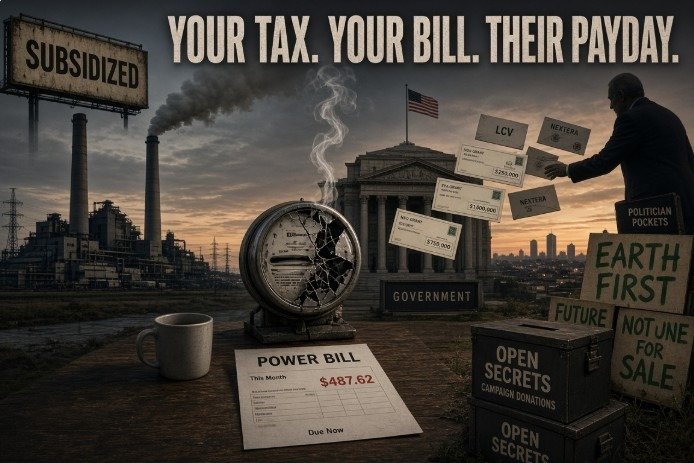
WASHINGTON — Bureaucracies did not “save the grid.” They turned the power plant into a two-sided cash register. One side pays the plant to stay open, or to close. The other side pays the activist shop to sue it. You pay both. Then the bill on the kitchen table goes up.
Electricity prices rose about 13 percent from 2022 to 2025. In 47 states the light bill climbed in a single year. Data centers, aging wires, gas swings, and wildfire costs all matter. So does policy that treats generation as a political asset instead of a machine that has to run. Plants collect tax credits and emergency orders. Ratepayers collect the remainder. That is not a mystery. That is a rate case with a flag on it.
The other half of the machine is the NGO. The EPA’s Greenhouse Gas Reduction Fund parked $20 billion with eight nonprofits — some newly assembled, some staffed by the last administration — to move “climate finance.” Other Biden-era awards put hundreds of millions toward groups that openly oppose nuclear and hydrocarbons, which still carry most of the load. Tax dollars in. Lawsuits and “just transition” out. The plant is subsidized on Monday and targeted on Tuesday. The household is billed on the first.
OpenSecrets is not poetry. In the 2023–24 cycle, electric-utility PACs sent about $12.4 million to federal candidates — $7.8 million to Republicans, $4.5 million to Democrats. Oil-and-gas PACs added $13.0 million, heavily Republican. Renewable PACs split both ways. Environment-sector money ran the other direction: League of Conservation Voters and allied funds poured tens of millions almost entirely to Democrats and liberal outside groups. Activism is not a church plate. It is a payroll.
Democrats who cashed the energy/activism ledger (OpenSecrets, 2023–24 unless noted): Sen. Martin Heinrich (D-N.M.), Energy Committee, about $309,000 from electric utilities. Sen. Jon Tester (D-Mont.) about $370,000 from the environment sector. Sen. Sherrod Brown (D-Ohio) about $347,000 from the same. Rep. Frank Pallone (D-N.J.), longtime Energy and Commerce hand, a regular utility-PAC stop. Rep. Henry Cuellar (D-Texas), more than $1.3 million career from oil and gas.
Republicans on the same ledger: Sen. John Barrasso (R-Wyo.) about $267,000 from electric utilities. Sen. John Curtis (R-Utah) about $222,000. House Speaker Mike Johnson and Leader Steve Scalise — Scalise more than $2.4 million career from oil and gas. Sen. Lisa Murkowski (R-Alaska), more than $2 million career from oil and gas. Utility PACs also fed leadership committees that recycle the money into swing races.
What the heck is going on is not a slogan. It is a loop. Congress writes the credit. The agency writes the grant. The NGO writes the press release and the lawsuit. The utility writes the PAC check. Earth-branded activism becomes a donation stream. The plant becomes a prop. The patriot who still works nights to keep megawatts on the bus is told he is the problem — while both parties take the envelope.
A republic would ask one question: does this keep the lights on at a price a family can pay? A conglomerate asks who gets the credit, who gets the grant, and who gets the check. Until that changes, the meter is not broken. It is doing exactly what it was built to do.
— Josiah Hale, WAA1776
References